
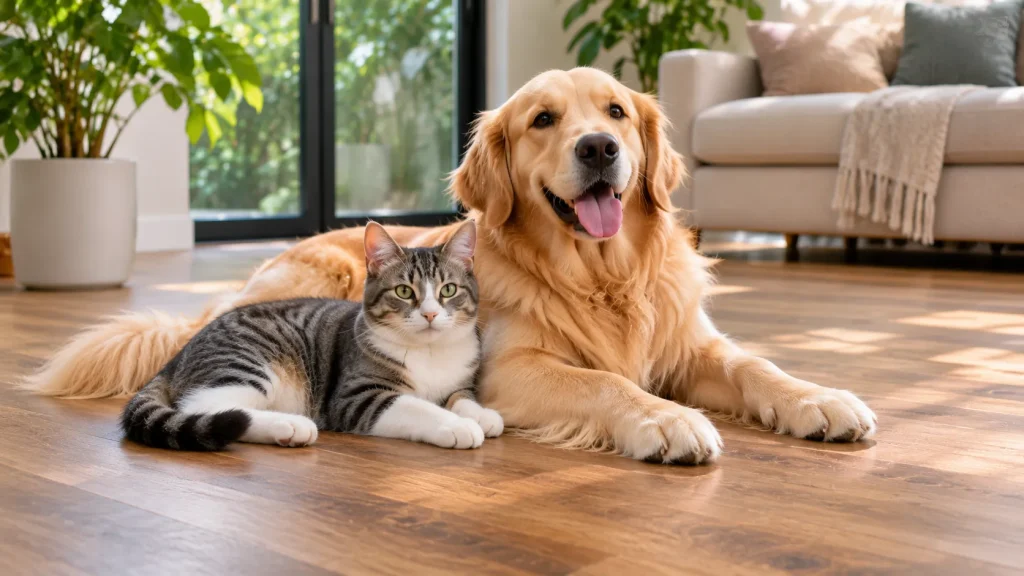
Choosing the right flooring becomes more important when you share your home with pets. Dogs running through hallways, cats scratching surfaces and accidental spills can all affect how your floor looks and performs over time.
The best flooring for pets should offer a practical balance of scratch resistance, moisture protection, grip, comfort and easy maintenance. Engineered wood, luxury vinyl flooring and porcelain tiles are popular options, but each has different advantages and limitations.
Whether you have a large dog, a playful puppy, an older cat or several pets, understanding how different flooring materials perform can help you make the right investment.
In this guide, we compare engineered wood, laminate, luxury vinyl tile (LVT), porcelain tiles and carpet to help you find the best flooring for your home and lifestyle.
What Is the Best Flooring for Pets?
The best flooring for homes with pets depends on your priorities. Engineered wood offers a balance of natural appearance, long-term value and repair potential. Luxury vinyl is a practical choice for households prioritising moisture resistance and easy cleaning, while porcelain tiles offer excellent durability and hygiene.
For homeowners who want the warmth and appearance of real wood without choosing solid timber, engineered wood can be an attractive long-term option. However, it is not completely scratch-proof or waterproof.
Before choosing a material, consider your pets’ behaviour, the rooms where they spend most of their time and the level of maintenance you are comfortable with.
What Should You Look for in Pet-Friendly Flooring?
Not every flooring material performs equally well in a home with pets. Before making a decision, consider these six important factors.
1. Scratch Resistance
Pet claws can leave marks on flooring, particularly when dogs run across surfaces or cats repeatedly scratch in the same areas.
Look for flooring with a durable protective surface. Textured finishes, suitable lacquer coatings and high-quality wear layers can help reduce visible everyday damage.
Remember that scratch resistance does not mean scratch-proof. Even durable flooring can be damaged by sharp claws, grit and heavy impact.
2. Water and Stain Resistance
Water bowls, muddy paws, accidents and spills are common challenges for pet owners.
Choose flooring that can handle everyday moisture and can be cleaned easily. Water-resistant flooring is useful, but it is important to distinguish between water-resistant and waterproof products.
Engineered wood and many laminate products require particular care around standing water and exposed joints.
3. Grip and Slip Resistance
Smooth flooring can make it difficult for pets to maintain their footing, especially when running or changing direction.
This is particularly important for older dogs, puppies and pets with mobility difficulties.
Consider brushed, textured or appropriately finished surfaces rather than highly polished flooring. Rugs and runners can also provide additional grip.
4. Comfort Underfoot
Flooring affects how comfortable pets feel when walking, resting and playing.
Wood, vinyl and carpet generally feel warmer than porcelain tiles. However, carpet can retain fur, odours and dirt, making maintenance more demanding.
5. Cleaning and Hygiene
Pet-friendly flooring should be easy to clean without requiring specialist maintenance every time an accident occurs.
Non-porous surfaces such as properly finished LVT and porcelain tiles are generally easier to maintain. Wood flooring also stays hygienic with appropriate cleaning, provided spills are dealt with promptly.
6. Repairability and Long-Term Value
Consider what happens if your flooring becomes scratched, stained or damaged.
Some engineered wood products may allow surface refinishing, depending on the thickness of the real wood wear layer and manufacturer specifications. Laminate and most vinyl products cannot be sanded and refinished in the same way.
A floor that can be maintained or repaired may offer better long-term value than one that needs complete replacement after significant damage.
Best Flooring Options for Homes with Pets Compared
Let’s compare the five most common flooring options based on their performance in pet-friendly households.
1. Engineered Wood Flooring
Engineered wood flooring is an excellent option for homeowners who want the natural beauty of real wood with a construction designed to provide greater dimensional stability than solid timber.
It consists of a real wood surface layer supported by a multi-layer core. This construction helps the floor cope with changes in temperature and humidity more effectively than many solid wood alternatives.
Advantages:
- Natural wood appearance and texture.
- Available in different finishes, colours and plank styles.
- More dimensionally stable than solid wood.
- Certain products can be refinished, depending on wear-layer thickness.
- Can add warmth and character to living spaces.
- Some products are suitable for underfloor heating.
Disadvantages:
- Pet claws can still leave scratches and marks.
- Not waterproof.
- Standing water can damage the surface and joints.
- Requires suitable cleaning and maintenance.
- Refinishing is not possible for every engineered wood product.
Best for: Homeowners who value natural aesthetics, long-term performance and the possibility of repairing or refinishing their flooring.
For homes with pets, consider brushed textures and durable lacquered or hardwax-oiled finishes. Keep pet nails trimmed and clean spills immediately.
Explore engineered wood flooring at Trade Flooring.
2. Laminate Flooring
Laminate flooring is a popular choice for homeowners looking for a practical and affordable flooring option.
It generally features a decorative photographic layer protected by a transparent wear layer, supported by a composite core.
Modern laminate products can offer good resistance to everyday surface scratching, making them suitable for some households with active pets.
Advantages:
- Generally affordable compared with real wood.
- Good surface scratch resistance in suitable products.
- Available in various wood-effect designs.
- Easy to clean and maintain.
- Some ranges offer enhanced moisture protection.
Disadvantages:
- Water can enter through joints if the product is not adequately protected.
- Cannot normally be sanded or refinished.
- Damaged boards may need replacement.
- Some finishes can be slippery for pets.
- May feel harder underfoot than wood or carpet.
Best for: Budget-conscious pet owners looking for a practical floor with a wood-inspired appearance.
If choosing laminate, check its abrasion rating, moisture protection and suitability for domestic use. Do not assume every laminate product is waterproof.
3. Luxury Vinyl Tile (LVT)
Luxury Vinyl Tile is a practical flooring option for households with pets because many products offer excellent moisture resistance and straightforward cleaning.
LVT is available in wood, stone and tile-inspired designs. It can provide a realistic appearance without the maintenance requirements of natural timber.
Advantages:
- Many products are waterproof.
- Easy to clean after everyday spills.
- Comfortable underfoot compared with porcelain tiles.
- Available in numerous designs and finishes.
- Generally low-maintenance.
- Suitable options are available for underfloor heating.
Disadvantages:
- Sharp objects and heavy furniture can still damage the surface.
- Not all LVT products have the same wear-layer quality.
- Deep scratches may be difficult to repair.
- Some smooth finishes can be slippery.
- It does not offer the same natural material characteristics as real wood.
Best for: Busy households with puppies, multiple pets or animals that frequently bring dirt and moisture indoors.
Choose a quality product with an appropriate wear layer and textured finish. Check the manufacturer’s specifications for domestic use and maintenance.
4. Porcelain Tile Flooring
Porcelain tiles are among the most durable flooring options for households that need excellent moisture resistance and easy cleaning.
They are particularly useful in kitchens, utility rooms and areas where muddy paws and spills are common.
Advantages:
- Excellent resistance to moisture.
- Highly durable against everyday wear.
- Easy to clean.
- Resistant to many household stains.
- Available in numerous colours, sizes and designs.
- Compatible with suitable underfloor heating systems.
Disadvantages:
- Hard surface can be uncomfortable for pets.
- Smooth, polished tiles can be slippery.
- Can feel cold without underfloor heating.
- Dropped objects may break.
- Damaged tiles can require specialist replacement.
Best for: Households prioritising durability, hygiene and moisture resistance, particularly in kitchens and utility areas.
If you choose porcelain tiles, look for a surface with suitable slip resistance. Textured finishes can provide better traction than polished tiles.
5. Carpet Flooring
Carpet provides softness and warmth, making it comfortable for pets that enjoy resting or playing indoors.
However, it can be more difficult to maintain in homes with animals, especially those prone to shedding, muddy paws or toilet-training accidents.
Advantages:
- Soft and comfortable underfoot.
- Provides warmth and insulation.
- Offers better traction than many smooth hard floors.
- Helps absorb sound.
- Available in different textures and colours.
Disadvantages:
- Traps pet hair, dust and dirt.
- Can absorb urine and other liquids.
- May retain unpleasant odours.
- Requires regular vacuuming and deep cleaning.
- Pet claws can pull or damage carpet fibres.
Best for: Households with older, calmer pets or owners who prioritise comfort and are prepared for regular cleaning.
If choosing carpet, consider low-pile, tightly woven options that are easier to maintain. Avoid delicate looped constructions if your pets frequently scratch or dig at the floor.
Pet-Friendly Flooring Comparison Table
The following table provides a quick comparison of how different flooring materials generally perform in homes with pets.
Flooring type | Scratch resistance | Moisture resistance | Grip | Comfort | Maintenance |
Engineered wood | Moderate | Moderate | Good with texture | Good | Moderate |
Laminate | Good | Varies by product | Moderate | Moderate | Easy |
LVT | Good to excellent | Excellent in waterproof products | Good with texture | Good | Easy |
Porcelain tile | Excellent | Excellent | Varies by finish | Low | Easy |
Carpet | Low to moderate | Low | Good | Excellent | High |
These are general comparisons, not guaranteed product ratings. Actual performance depends on the product specification, surface finish, installation and maintenance.
What Is the Best Flooring for Different Types of Pets?
Different pets create different flooring challenges. Consider their age, size, activity levels and behaviour before making a decision.
Best Flooring for Large Dogs
Large dogs can create greater impact and friction when running, playing and moving around the house.
Consider quality LVT, porcelain tiles with a suitable textured finish or engineered wood with a durable protective coating.
If choosing wood, pay particular attention to finish, wear-layer thickness and maintenance requirements.
Read our guide to [wood flooring for dogs] to understand how engineered wood performs in homes with active dogs.
Best Flooring for Puppies
Puppies are still learning where to play and toilet. Accidents and muddy paws are common during early development.
Waterproof LVT is a practical choice because it is easy to clean and can handle everyday spills.
A textured surface can also help puppies maintain their grip while learning to walk and run.
Best Flooring for Older Dogs
Older dogs may experience joint stiffness, reduced mobility and difficulty walking on slippery surfaces.
Avoid highly polished flooring where possible. Choose textured finishes and add non-slip rugs or runners in frequently used areas.
Comfort and traction should take priority over scratch resistance.
Best Flooring for Cats
Cats may scratch surfaces, shed fur and occasionally have accidents outside their litter trays.
LVT and suitable engineered wood can work well, depending on the cat’s behaviour and the owner’s maintenance preferences.
If choosing engineered wood, a textured finish can help reduce the visibility of minor surface marks.
Best Flooring for Small Animals
Rabbits, guinea pigs and other small animals may create localised moisture, food spills and scratching damage.
A surface that is easy to clean and resistant to moisture is useful around their living areas. LVT and porcelain tiles are practical options, provided the flooring is not excessively slippery.
What Is the Best Flooring for Different Rooms in a Pet-Friendly Home?
The best flooring choice may vary from room to room.
Room | Recommended flooring | Why? |
Hallways | Engineered wood or LVT | Handles regular foot traffic and is relatively easy to maintain |
Kitchen | LVT or porcelain tile | Better protection against everyday spills |
Living room | Engineered wood or LVT | Combines appearance, comfort and practicality |
Utility room | Porcelain tile or LVT | Suitable for muddy paws and frequent cleaning |
Bedroom | Engineered wood or carpet | Offers warmth and a comfortable atmosphere |
You do not necessarily need to use the same flooring throughout your property. Combining different materials can provide a better balance between appearance, durability and maintenance.
How Can You Prevent Pets from Slipping on Wood Flooring?
Slipping can be a concern for pets, particularly older dogs and animals with mobility difficulties.
A few simple measures can help create a safer indoor environment.
Choose textured flooring: Brushed and textured surfaces can offer better traction than highly polished finishes.
Use rugs and runners: Place suitable non-slip rugs in hallways, near doorways and along frequently used routes.
Keep pet nails trimmed: Long nails can affect how dogs position their paws and maintain traction.
Clean spills immediately: Water, food and cleaning residues can make flooring slippery.
Create comfortable resting areas: Provide suitable mats or beds where pets can rest without sliding across the floor.
If your pet has mobility or joint problems, consult your veterinarian about suitable home adaptations.
How to Maintain Flooring in a Home with Pets
Regular maintenance helps keep your flooring in good condition, regardless of the material.
Follow these practical tips:
- Trim pet nails regularly: This helps reduce scratching and surface damage.
- Clean muddy paws: Use a doormat near entrances to reduce dirt and grit.
- Remove spills immediately: Avoid leaving urine, water or other liquids on flooring.
- Vacuum regularly: Remove pet hair, dust and abrasive particles.
- Use suitable cleaning products: Follow the flooring manufacturer’s cleaning instructions.
- Protect high-traffic areas: Use appropriate rugs and runners.
- Avoid harsh chemicals: Abrasive cleaners can damage protective finishes.
For engineered wood flooring, avoid excessive water and steam cleaning. Use an approved wood floor cleaner and follow the manufacturer’s care instructions.
You can also read the Trade Flooring Care Guide for further maintenance advice.
Is Engineered Wood Flooring Worth It for Pet Owners?
Engineered wood flooring can be worth considering if you want the natural appearance of real timber and a floor that may be maintained or refinished over time.
Unlike laminate and most LVT products, some engineered wood floors have a genuine wood wear layer that can be sanded and refinished, depending on its thickness and the manufacturer’s recommendations.
It also offers a greater sense of natural warmth and character than many synthetic alternatives.
However, it is important to understand its limitations. Engineered wood is not waterproof or scratch-proof. Households with very active pets or frequent accidents may find LVT or porcelain tiles more practical.
The best choice depends on whether you prioritise natural aesthetics, moisture protection, maintenance or long-term repairability.
At Trade Flooring, you can explore different engineered wood finishes, plank designs and parquet styles to find an option that suits your home.
Frequently Asked Questions About Pet-Friendly Flooring
Porcelain tiles and quality LVT are generally among the most scratch-resistant options for pet-friendly homes. However, performance varies depending on the product, surface finish and quality.
Yes. Engineered wood can be suitable for homes with cats, provided owners understand that claws may leave scratches. Brushed finishes and suitable protective coatings can help manage everyday wear.
LVT is generally the more practical option when moisture protection is important. Laminate may offer good surface scratch resistance, but water can damage joints in products without enhanced moisture protection.
Yes. Pet claws can scratch engineered wood, particularly if nails are long or the floor has a delicate finish. Regular nail trimming and suitable protective coatings can help minimise damage.
Trim your pet’s nails, use suitable rugs and runners, clean dirt regularly and choose a protective wood finish. Avoid dragging heavy furniture across the floor.